All products

Solver

SolvLRDE

Answer at time T without paying for every micro-step in between.

Long horizons and stiff linear structure punish time-marching solvers — you pay in steps, in stiffness, and in repeated factorizations across scenarios. SolvLRDE targets the linear response directly so scenario grids, strike ladders, and EMTP-style studies scale with factorization reuse, not with horizon length.

  • Scenario and parameter sweeps that used to be overnight can fit in interactive design loops.
  • Stable cost story when stiffness would force microscopic steps in explicit integrators.
  • One factorization backbone reused across strikes, faults, and grid contingencies.
  • Vertical SKUs align to how buyers fund programs — markets, grid, thermal, control, climate.
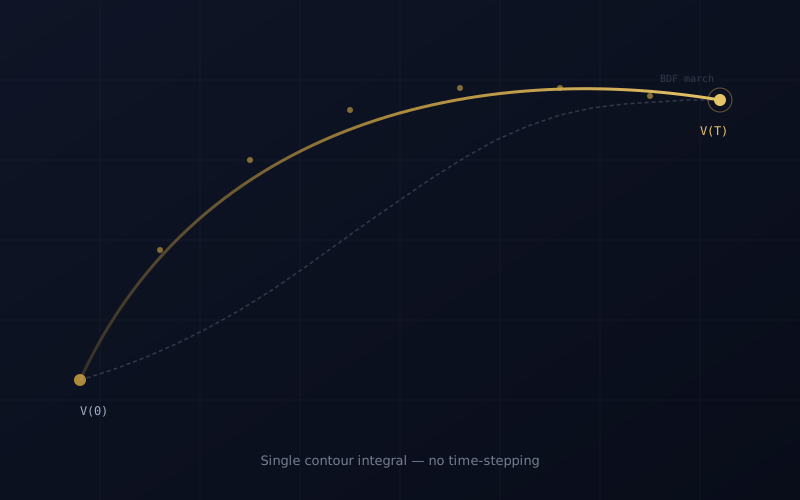
Contour integral bypassing the time-stepping march, collapsing directly to the final answer.

Imagine yourself in these moments. Same product, different industries.

Hedge-fund pricing

The vol surface that takes three minutes.

Your vol surface has 6,000 cells — 200 strikes times 30 maturities. Every time the market moves, the surface has to be re-priced. Today the inner loop is a time-stepper: Crank-Nicolson, BDF, ADI. It marches through hundreds of small steps. The 6,000-cell surface takes three minutes. The trader waits.

Imagine a pricing engine that computes the answer at T directly — one contour integral, one LU factorization reused across every strike in the same vol bucket. The 6,000-cell surface takes two seconds. The trader doesn’t wait.

Power grid

The transient that crashed the model.

A grid operator simulating electromagnetic transients on a 10,000-bus network. Each EMTP time step is a linear solve. The simulation marches through thousands of steps at microsecond resolution. A transformer switching event changes the stiffness by four orders of magnitude. The time-stepper chokes.

SolvLRDE evaluates the settled state directly. No marching. Cost is independent of stiffness. The same solver handles gentle dynamics and the worst switching transient.

Defence radar V&V

The 10,000-cell campaign.

A phased-array antenna simulation team runs V&V across scan angle × frequency × element calibration. Thousands of cells. Each is a time-stepper marching from t=0 to the settled state. The campaign takes 45 minutes of single-core scipy. SolvLRDE does it in under 90 seconds with 4–6 orders of magnitude better precision.

Explore Deep FIELD

Governed research, licensable IP, partner programs.

For investors

Company brief, evidence, and data room access.